The dream of becoming a commercial airline pilot has never been more achievable, yet navigating the flight training landscape can feel overwhelming. Prospective aviators are often confronted with a high-stakes choice: enroll in a massive, multi-campus flight "factory" with hidden costs and months-long checkride backlogs, or struggle through an unstructured part-time school where 70% to 80% of student pilots drop out before ever reaching their goals.
At 609 Aviation Flight Training, located at Cape May County Airport (KWWD) in Rio Grande, New Jersey, we built a better pathway.
Our Accelerated Professional Pilot Program is an immersive, zero-to-commercial career track designed to take motivated students from their very first discovery flight all the way through Commercial Pilot certification and Certified Flight Instructor (CFI/CFII) ratings [cite: 8, 261]. Guided by legacy airline leadership, an in-house FAA Designated Pilot Examiner (DPE), modern glass-cockpit aircraft, and the uncongested airspace of Cape May County, 609 Aviation offers the fastest, most efficient, and most supportive route to an airline career.
The 609 Aviation Career Advantage
While national flight academies sell speed, many suffer from structural bottlenecks that cost students thousands of dollars in unexpected fees and lost time. Here is how 609 Aviation sets a new standard for professional pilot education:
1. In-House FAA DPE Leadership — Zero Checkride Delays
Across the United States, the single biggest bottleneck in flight training is waiting for an FAA Designated Pilot Examiner (DPE). Students at national academies frequently finish their flight syllabus only to wait 30 to 90 days for an available examiner, resulting in "skill rot," expensive refresher flights, and thousands in extra rental fees.
At 609 Aviation, COO and Legacy Airline Captain Richard Washart is an active FAA Designated Pilot Examiner. Our leadership team integrates checkride standards directly into daily training. When you reach Airman Certification Standards (ACS) proficiency, your checkride is scheduled seamlessly without delays.
2. Transparent Pricing vs. Factory Academy Hidden Costs
National "zero-to-hero" programs advertise package prices between $102,000 and $124,000+, but those numbers rarely reflect total out-of-pocket expenses. Many big-box flight schools exclude mandatory DPE checkride fees ($10,000–$12,000 career total), iPad app subscriptions, training center location premiums (up to $5,000), or bill heavily at hourly overage rates if a student requires extra flight hours beyond near-minimum estimates.
609 Aviation operates on a principle of total financial transparency. You receive clear, upfront quotes covering flight hours, instructor time, and ground instruction, with no hidden monthly club dues or surprise administrative fees.
3. Uncongested Coastal Airspace at Cape May Airport (KWWD)
Training at a crowded metropolitan airport means sitting on hot tarmac waiting for air traffic control clearance, burning expensive fuel while logging zero learning value.
Operating at Cape May County Airport (KWWD) gives 609 Aviation students an extraordinary operational edge:
Multiple Active Runways & Onsite Fueling: Immediate taxi-to-takeoff capability keeps every flight hour focused on maneuver mastery and landings.
Diverse Airspace: Practice non-towered pattern entries locally while taking advantage of nearby Class C and Class D controlled airspace for real-world ATC communication practice.
Scenic Coastal Flying: Experience coastal weather patterns and crosswind practice in an inspiring environment.
4. Next-Generation Training Fleet — The Sling 2 & Sling 2M
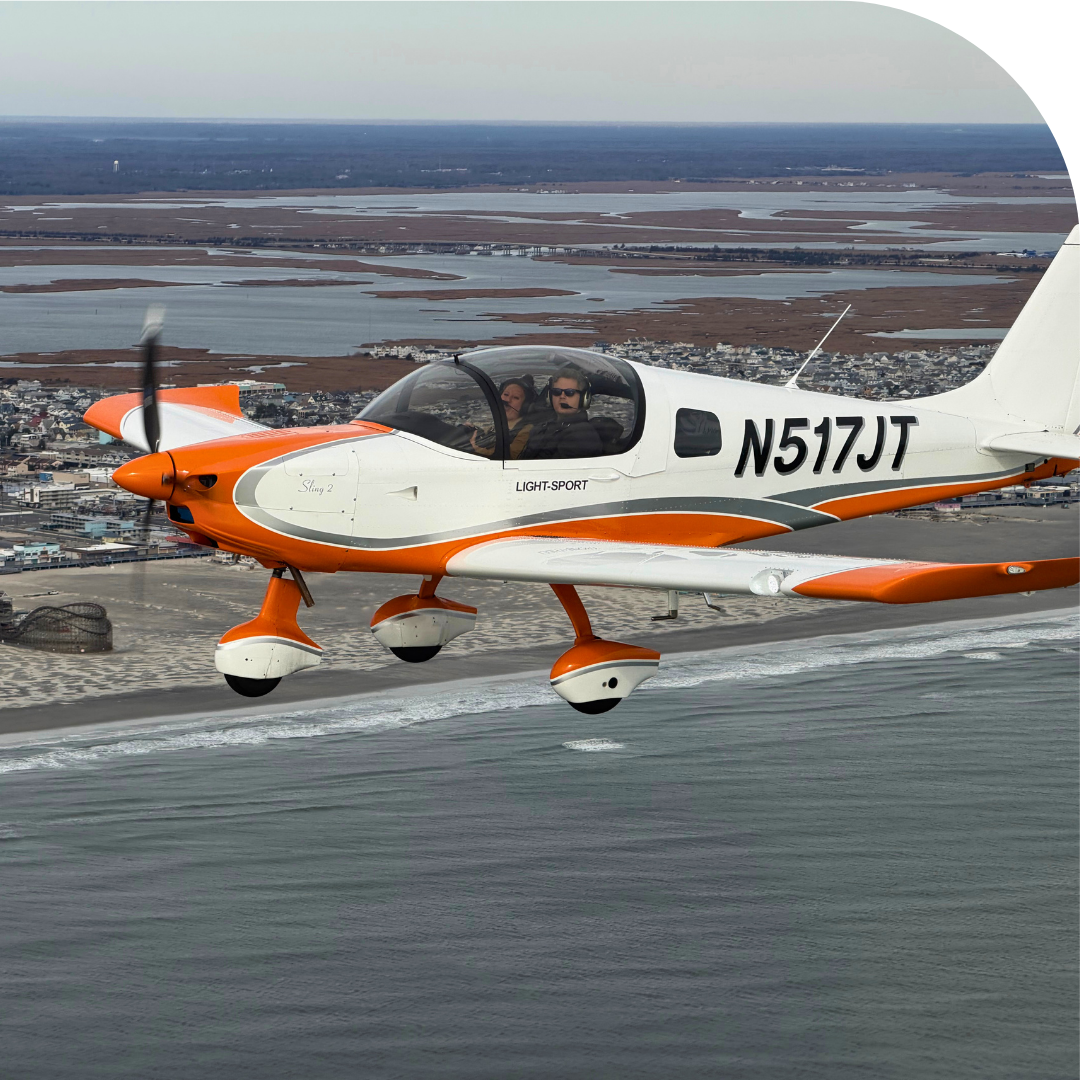
Instead of learning in aging 1970s steam-gauge airframes, 609 Aviation students train in the modern Sling 2 (and MOSAIC-compliant Sling 2M). Featuring lightweight aluminum construction, responsive control sticks, Rotax 912iS fuel efficiency (~3.8 gph), and a full Garmin G3X Touch glass cockpit, the Sling prepares you for modern regional jet flight decks from Day .
Program Roadmap: From Zero Experience to Airline Ready
The Accelerated Professional Pilot Program is broken down into structured, high-yield phases that build muscle memory, aeronautical knowledge, and professional discipline without gaps.
Phase 1: Private Pilot Certificate (PPL)
Focus: Fundamental aircraft control, aerodynamic principles, airport pattern operations, emergency procedures, visual navigation (pilotage & dead reckoning), and your first solo flight.
Advantage: Immersive daily scheduling eliminates skill decay, helping you reach your solo and Private Pilot checkride faster and with fewer total flight hours.
Phase 2: Instrument Rating (IR)
Focus: Flying solely by reference to instruments under simulated and actual Instrument Meteorological Conditions (IMC).
Advantage: Master precision IFR approaches, holding patterns, and spatial disorientation recovery using our Garmin G3X Touch primary flight displays and G5 backup instrumentation.
Phase 3: Commercial Pilot Certificate (CPL - Single & Multi-Engine)
Focus: Mastery of high-precision commercial maneuvers (steep spirals, chandelles, lazy eights, eights-on-pylons), complex aircraft operations, and long-distance cross-country flight planning.
Advantage: Structured cross-country routes across regional hubs build real-world decision-making and crew resource management (CRM) discipline.
Phase 4: Certified Flight Instructor (CFI & CFII)
Focus: Transforming expert pilot knowledge into instructional mastery. Learn how to teach aerodynamics, weather theory, FARs, and cockpit procedures to new student pilots.
Advantage: Learn how to teach under instructors who possess the "heart of a teacher." Upon completing your CFI and CFII practical tests, 609 Aviation offers top-tier graduates the opportunity to join our flight instruction team.
Bridging the Gap to 1,500 Hours: Your Airline Career Launchpad
Under the FAA's 1,500-Hour Rule, earning your Commercial Pilot Certificate and CFI ratings is the doorway to your professional career. As a Certified Flight Instructor at 609 Aviation, you transition from paying for flight time to getting paid to build flight hours.
Working as a 609 Aviation CFI allows you to:
Build Quality PIC Hours: Log 60 to 90 hours per month instructing student pilots in our active Cape May training environment.
Sharpen Mastery Through Teaching: Nothing solidifies regulations, weather analysis, and flight safety quite like teaching it daily.
Step Directly to the Regionals & Majors: Reaching 1,500 hours opens immediate application windows for First Officer positions at regional carriers and mainline airlines.
Admissions & Pre-Arrival Checklist
Because our accelerated career track moves at an intensive pace, candidate readiness is vital. To hit the ground running:
Obtain an FAA 1st Class Medical Certificate: Ensures medical eligibility for future airline employment prior to financial investment.
Complete Ground School & Written Exams: Completing online ground school and passing your FAA Private and Instrument written tests early allows 100% of your daily focus to remain on cockpit mastery.
Schedule a Discovery Flight & Consultation: Visit Cape May County Airport (KWWD), tour our facilities, meet our flight team, and sit down with leadership to map out your personalized career timeline.
Take the Controls of Your Career
Stop letting flight factory waitlists and unstructured part-time programs delay your aviation goals. Train with legacy airline experience, zero checkride delays, and a team dedicated to your personal success [cite: 8, 259].
Contact 609 Aviation today to schedule your career consultation and discovery flight!
Location: Cape May County Airport (KWWD) | 175 Forrestal Rd, Rio Grande, NJ 08242
Phone: (609) 283-5192
Email: 609aviation@gmail.com
Website: 609aviation.com